The numbers to save
| Number | For | Good to know |
|---|---|---|
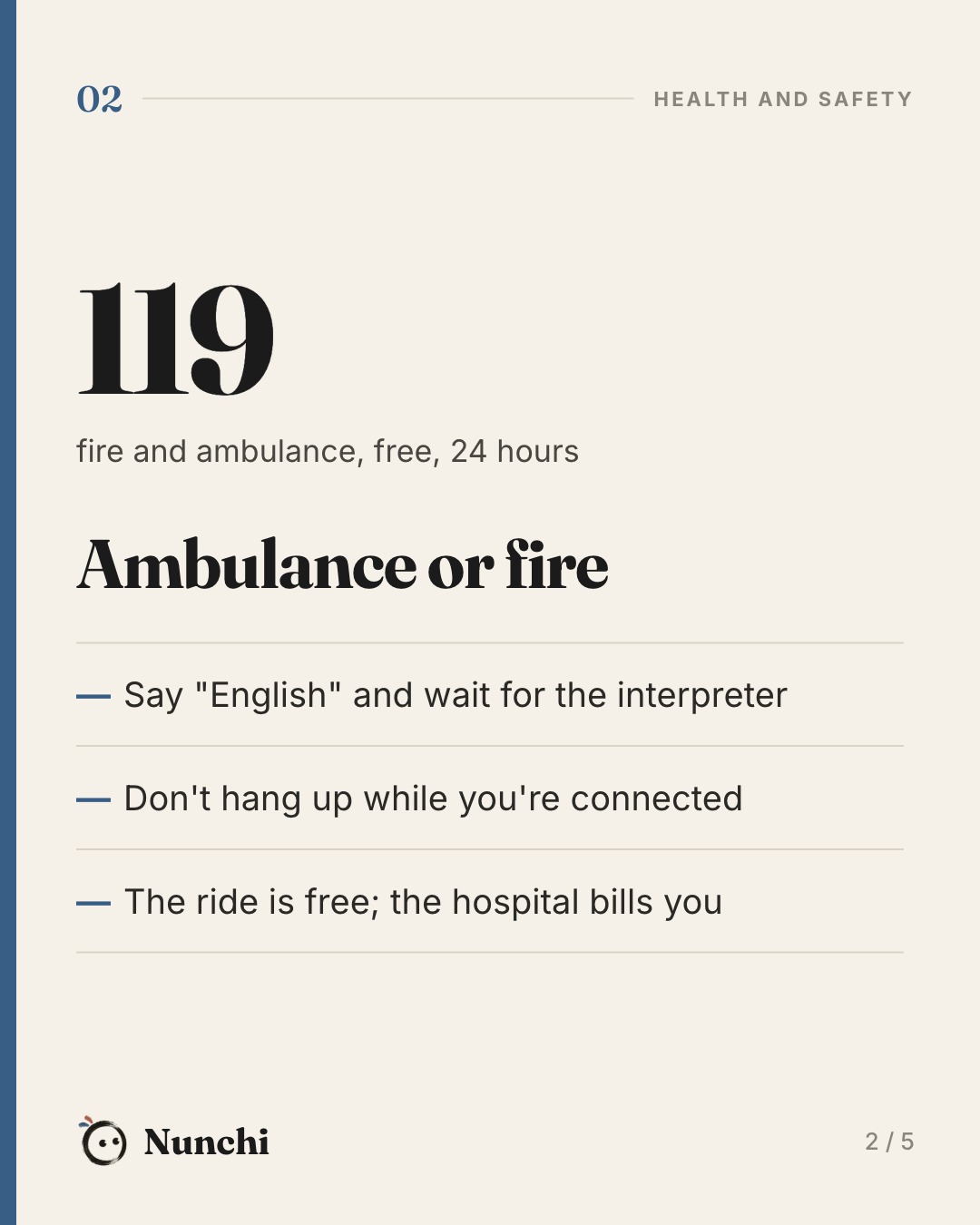
| 119 | Fire, ambulance, rescue | 24 hours. The ambulance is free. Interpreters available. |
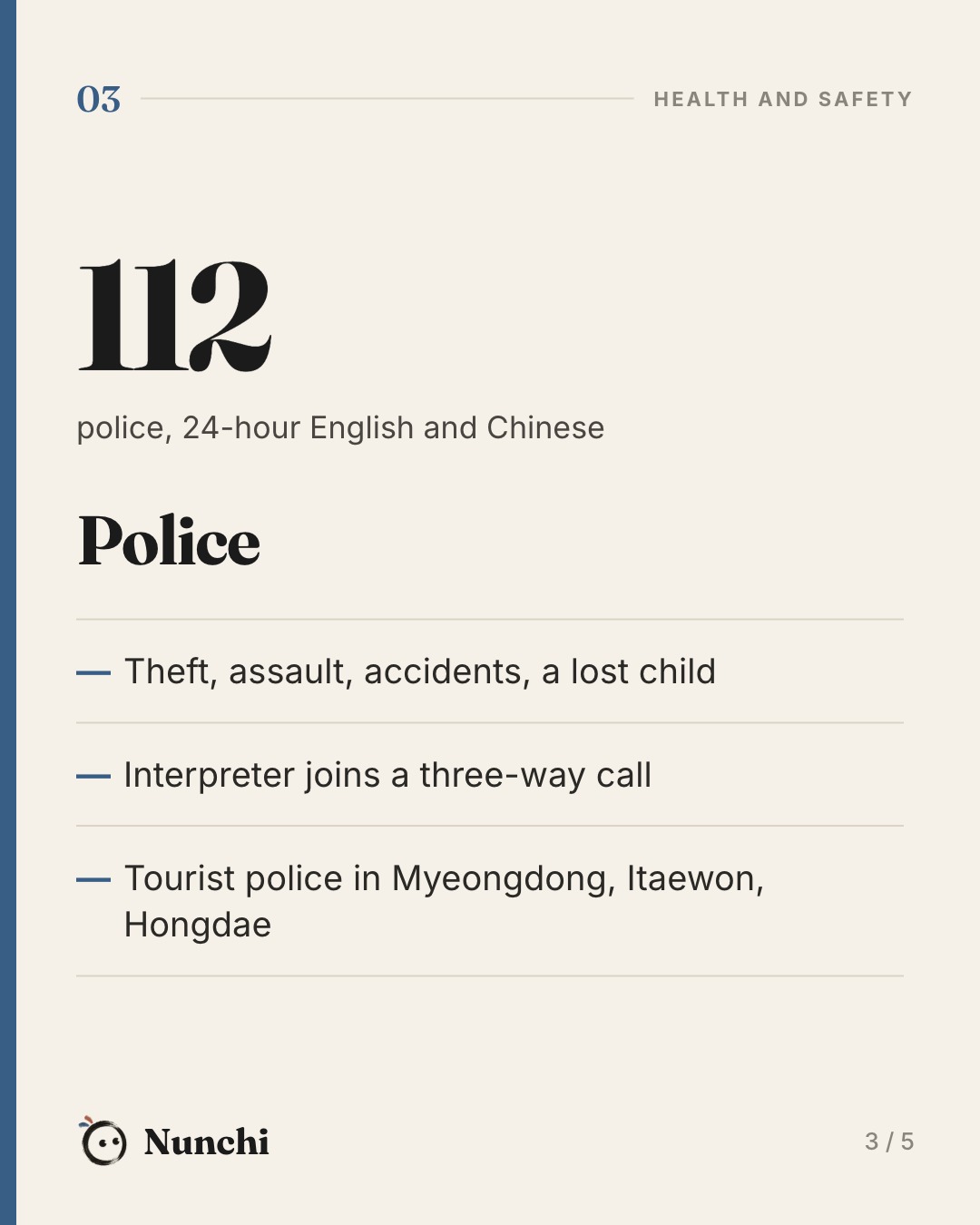
| 112 | Police: theft, assault, accidents, a missing child | 24-hour English and Chinese interpreters |
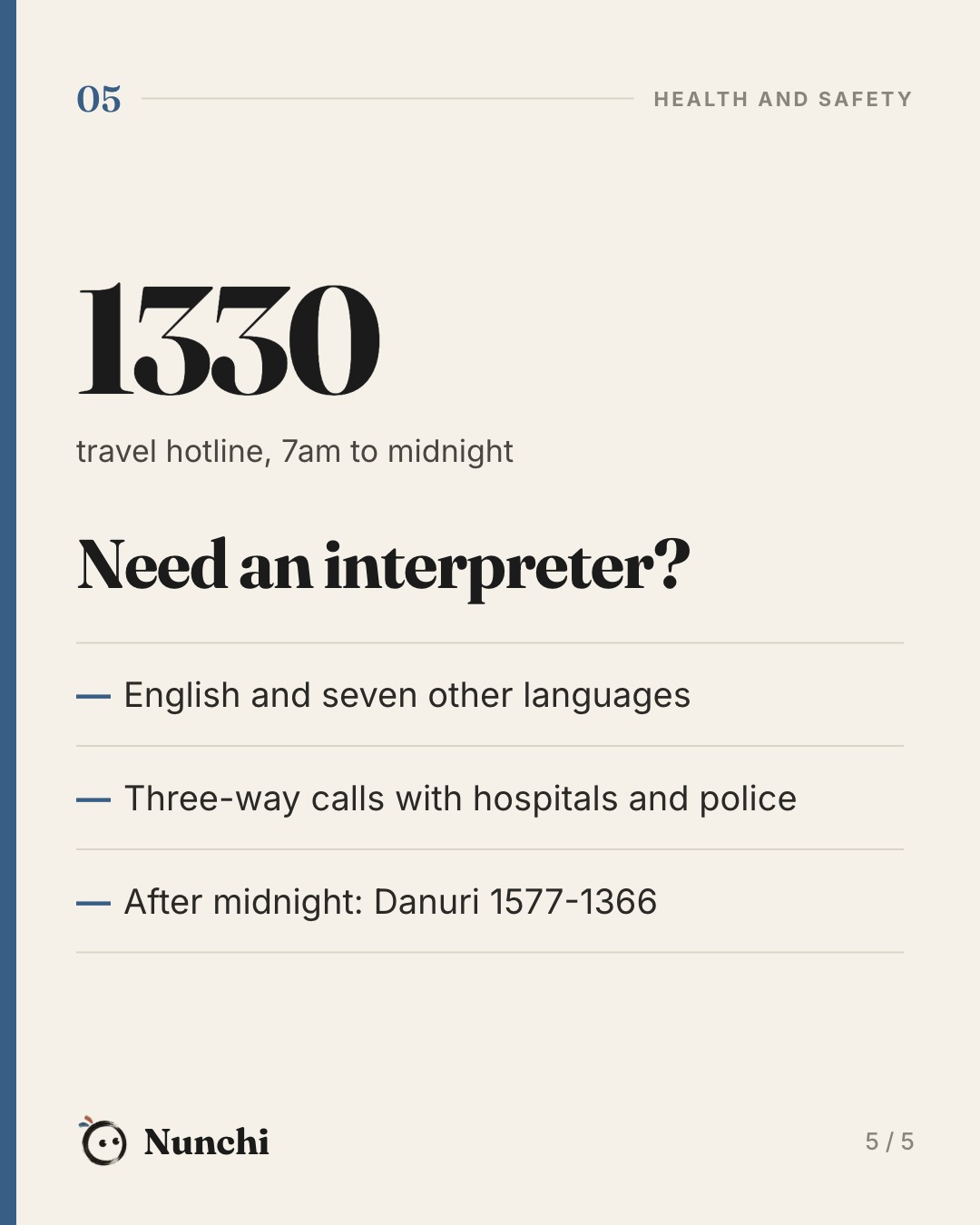
| 1330 | Korea Travel Hotline | Interpretation and advice, 7am to midnight. Not an emergency line. |
| 1577-1366 | Danuri helpline | 24-hour interpretation, including three-way calls |
| 1339 | KDCA medical helpline | 24 hours. Is this an ER case? Where's an open pharmacy? |
Dial 119 or 112 with no area code. If someone is badly hurt, in danger or there's a fire, call 119 or 112 first, not 1330.
Calling 119: fire and ambulance
The 119 ambulance is free, for visitors too. Seoul's 119 lists help in English, Chinese, Japanese, Mongolian and Vietnamese, and its staff also give first-aid instructions and hospital information over the phone. Say "English" clearly and stay on the line while they bring in an interpreter. Don't hang up if you hear a beep or silence while you're being connected.
The ambulance takes you to an emergency room. The ride is free, but the hospital bills you for treatment.
Have your location ready. The quickest ways to give it:
- In a building: the Korean address from Naver Map or from your booking confirmation, plus the floor.
- In the subway: the station name and the exit number you're nearest to.
- On the street: the name of the shop, hotel or landmark you're standing next to.
Calling 112: police
Since March 2024 the police have kept English and Chinese interpreters on duty around the clock at the 112 centre, joining your call as a three-way conversation. Use 112 for a theft, an assault, a road accident or a lost child. For things you've simply left behind, see our lost items guide.
In central Seoul, uniformed tourist police patrol areas such as Myeongdong, Itaewon and Hongdae, and some officers speak English or Chinese. They're a good first stop for a scam or a dispute with a shop or taxi.
What to say in Korean
Even a few words help a dispatcher before the interpreter joins. Show this on your phone if speaking is hard.
| Korean | Say it | Means |
|---|---|---|
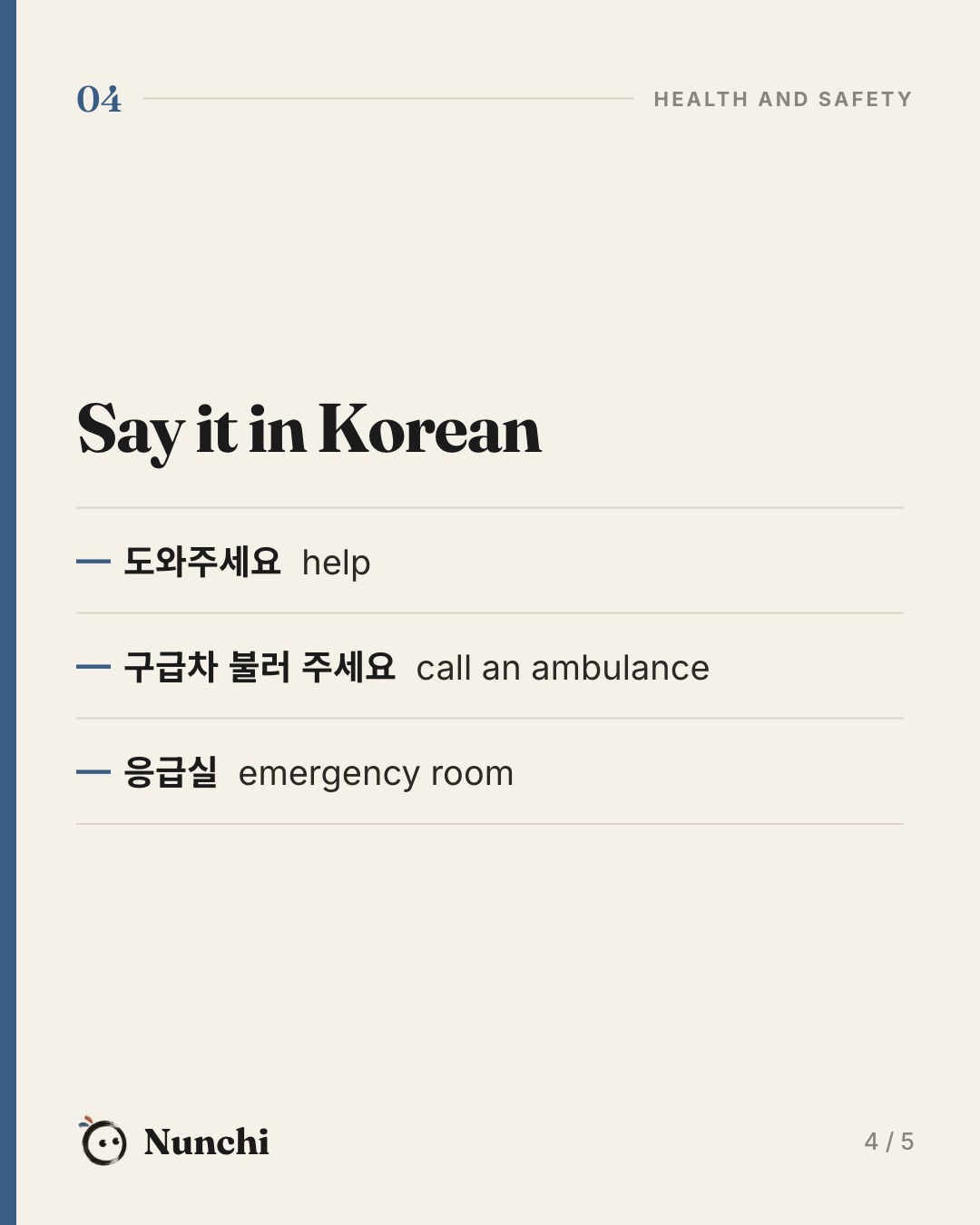
| 도와주세요 | dowajuseyo | Help |
| 구급차 불러 주세요 | gugeupcha bulleo juseyo | Please call an ambulance |
| 경찰 불러 주세요 | gyeongchal bulleo juseyo | Please call the police |
| 불이 났어요 | buri nasseoyo | There's a fire |
| 사람이 다쳤어요 | sarami dachyeosseoyo | Someone is hurt |
| 숨을 못 쉬어요 | sumeul mot swieoyo | I can't breathe / they can't breathe |
| 의식이 없어요 | uisigi eopseoyo | They're unconscious |
| 도둑맞았어요 | dodungmajasseoyo | I've been robbed |
| 영어 통역 부탁해요 | yeong-eo tongyeok butakhaeyo | An English interpreter, please |
| 여기 주소는 …이에요 | yeogi jusoneun …ieyo | The address here is … |
Interpretation lines
- 1330 Korea Travel Hotline: free, 7am to midnight, in eight languages including English, Japanese, Chinese, Russian and Vietnamese. It can set up a three-way call with a hospital, the police or 119. From a foreign phone, dial +82-2-1330.
- Danuri 1577-1366: 24-hour interpretation when 1330 is closed.
- 1588-5644: a volunteer interpretation line in 17 languages, listed by the Seoul city government.
- 1339: the Korea Disease Control and Prevention Agency's 24-hour line. Ask whether you need an ER or where a late-night pharmacy is, with an interpreter on a three-way call.
- 1345: the immigration helpline, 9am to 6pm in 20 languages, with English and Chinese until 10pm. For visa problems, not emergencies.
Emergency rooms (응급실)
An emergency room is an 응급실 (eunggeupsil), open 24 hours. Search the word on Naver Map, or use the ER finder on E-Gen, the national emergency medical site (Korean, but the map works). Patients are seen by how serious they are, not in order of arrival, so a minor problem can wait a long time.
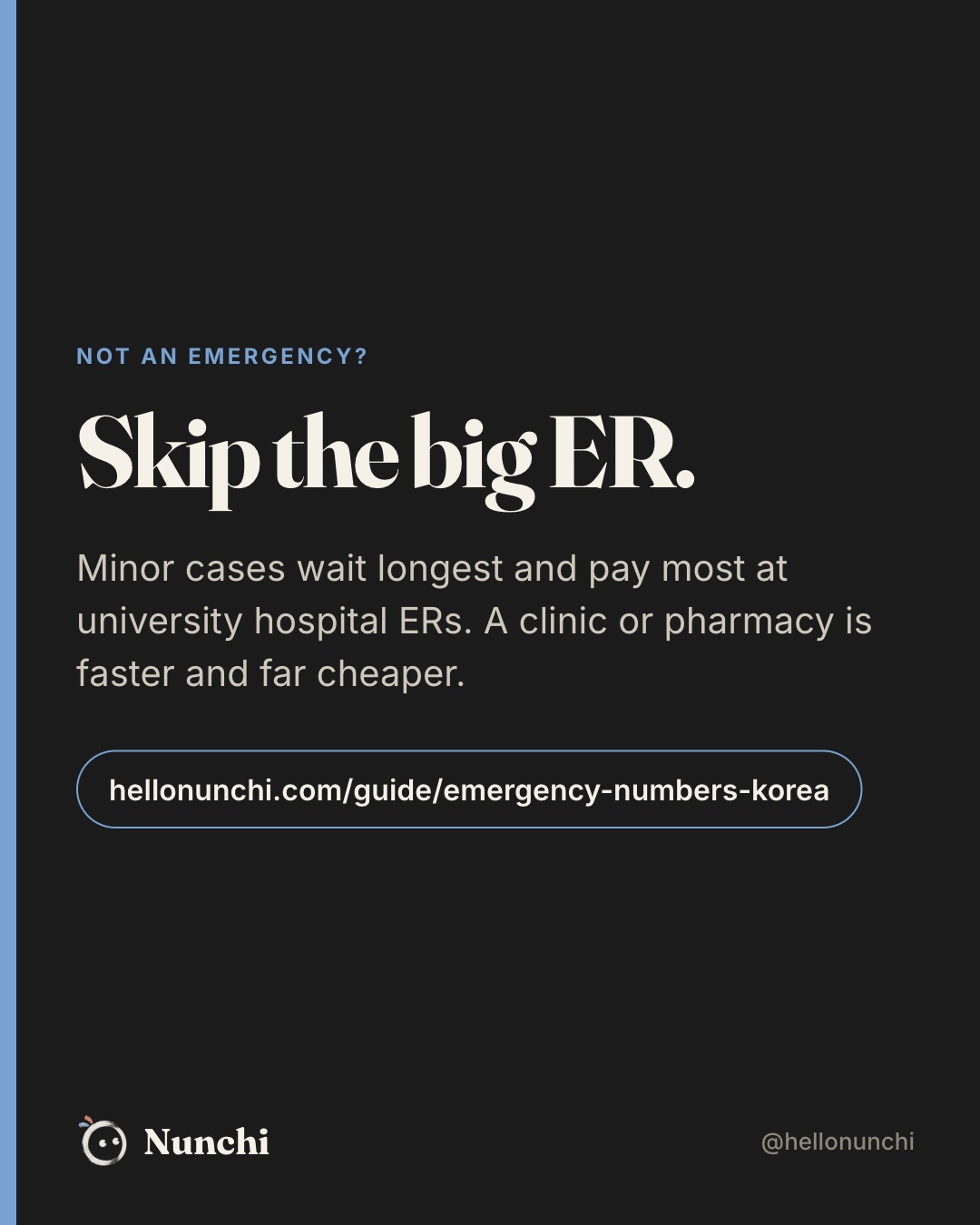
Korea deliberately makes minor ER visits expensive. Since 13 September 2024, insured Korean patients judged minor or non-urgent at the larger hospital ERs (regional and local emergency centres) pay 90% of the bill themselves. The government's estimate put the average a patient pays at about ₩220,000 at regional emergency centres and about ₩100,000 at local ones. As a tourist you're not in national health insurance, so you pay the full price for everything. For a fever, a cold or a twisted ankle, a clinic or a pharmacy is far cheaper: see how to see a doctor in Korea and our Korean pharmacy guide.
Bring your passport and a card, and expect to pay before you leave. If you're admitted, the hospital may ask for a 보호자 (bohoja, guardian) to help with basic care. Paid carers (간병인 ganbyeongin) can be hired, but they rarely speak English.
Before leaving, ask for the receipt (영수증) and the itemised bill (진료비 세부내역서). Your travel insurer will want both, and getting them later from abroad is much harder.
Your embassy and travel insurance
Save your embassy's emergency number before you fly; most list a 24-hour line on their website. The US Embassy in Seoul, for example, uses 02-397-4114 after hours. Embassies can issue an emergency travel document if your passport is lost or stolen, help if you're arrested or in hospital, contact your family with your consent and give you lists of local lawyers and interpreters. They can't pay your bills, give you money or get you out of trouble with the law.
That's why travel insurance matters. Medical care in Korea is good but can be expensive, and visitors pay the uninsured rate. Get a policy that covers treatment in Korea and medical evacuation, keep the insurer's 24-hour number with your passport and call them as soon as you're admitted.