The short version
Korea splits household rubbish into four streams: general waste in a paid bag, food waste on its own, recycling (free) and big items (reported and paid for). Every one of Seoul's 25 districts sets its own details by local rule, so collection days, bag colours and food-waste systems differ from one district to the next. If you're in an Airbnb, your host's sheet beats any guide, including this one. Ask 쓰레기 어디에 버려요? (sseuregi eodie beoryeoyo?, "where do I put the rubbish?") if there isn't one.
Rules got stricter in 2026. Since January, Seoul, Incheon and Gyeonggi can no longer send household rubbish straight to landfill, and Seoul officials now open bags in areas with poor sorting.
General rubbish: the 종량제 bag
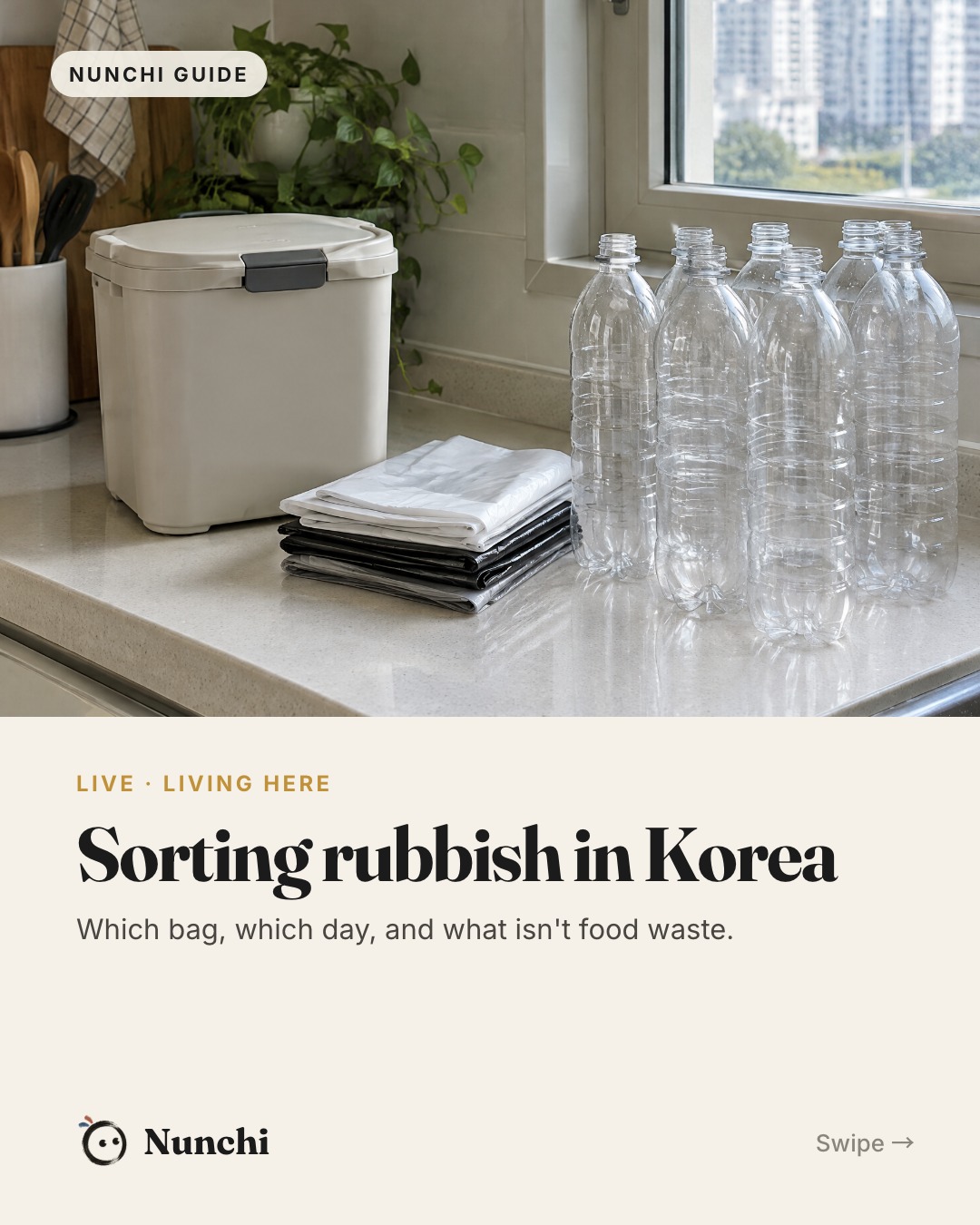
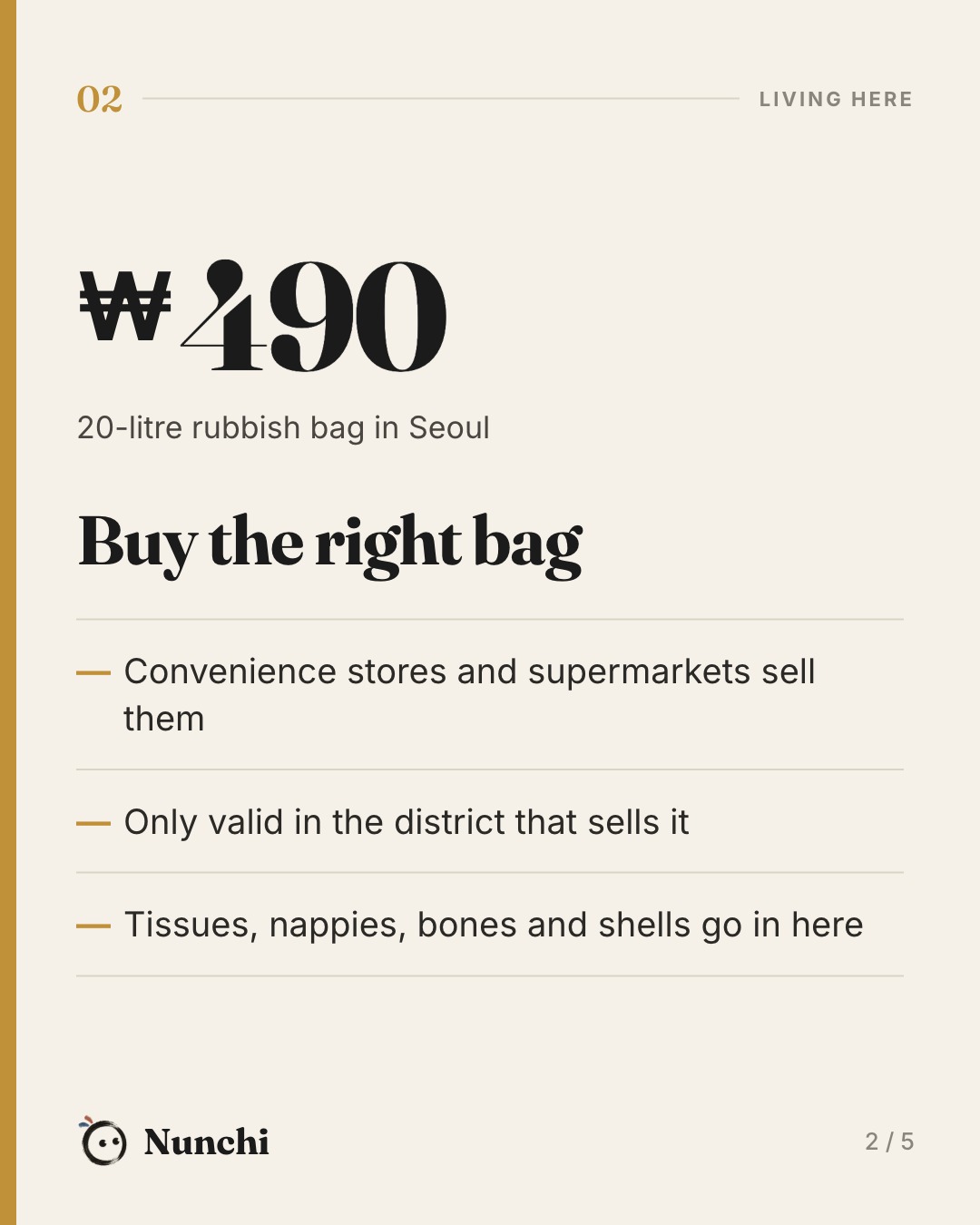
Anything that isn't food or recycling goes in a 종량제 봉투 (jongnyangje bongtu, volume-based bag). The bag price is the collection fee, so a plain carrier bag on the kerb won't be collected. Sizes run from about 5 to 50 litres. In Seoul a 20-litre bag costs ₩490, a price that hasn't moved in seven years.
- Where to buy: any convenience store (CU, GS25, 7-Eleven, emart24) or supermarket. They're usually behind the till, so ask: 종량제 봉투 20리터 주세요 (jongnyangje bongtu isip-riteo juseyo, "a 20-litre rubbish bag, please").
- Use your district's bag. Bags are printed with the district name and aren't valid elsewhere. Moved? Buy new ones.
- What goes in: tissues, wet wipes, nappies, dirty packaging, plus the food scraps listed below that don't count as food waste.
In March 2026 fears of a raw-material shortage set off panic buying, and some shops limited how many bags you could buy. The environment ministry said prices are set by local councils and would not go up.
Food waste: kept separate
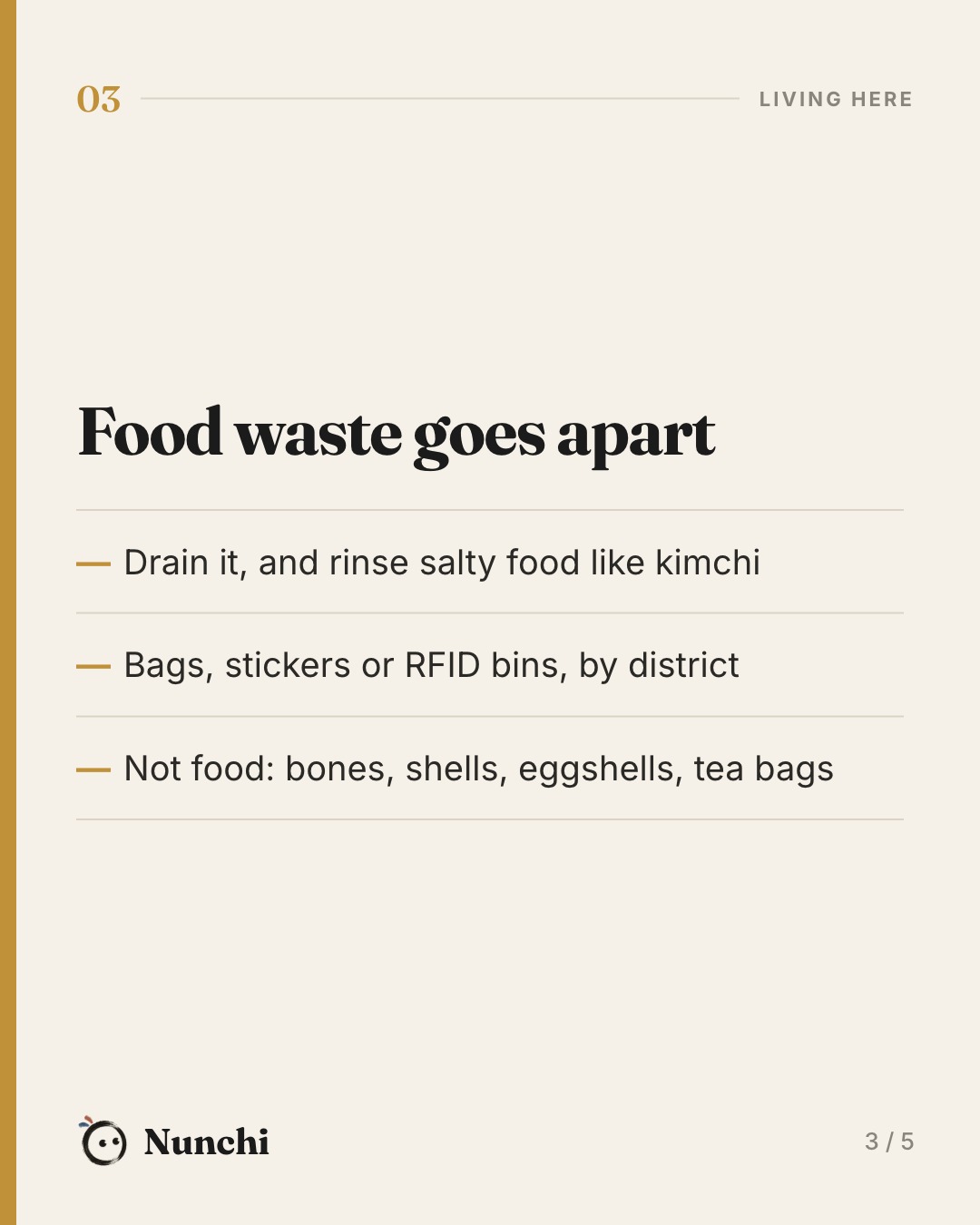
Food waste (음식물 쓰레기, eumsingmul sseuregi) becomes animal feed or compost, so it has to be clean food only. How you pay depends on where you live: a dedicated food-waste bag, a sticker on a shared bin, or, in many apartment blocks, an RFID bin that you open with a card and that weighs what you drop in. Small food-waste bags cost a few hundred won.
Drain off the liquid, rinse very salty food like kimchi or doenjang, and cut up big things like watermelon rind or cabbage. Seoul counts these as general rubbish, not food waste:
- Meat and fish bones, shellfish and crab shells
- Eggshells, nut shells, pineapple and coconut skin, peach and persimmon stones
- Onion, garlic and corn husks, spring-onion roots, chilli seeds
- Tea leaves and tea bags, coffee grounds, herbal medicine dregs
Recycling: free, but sorted
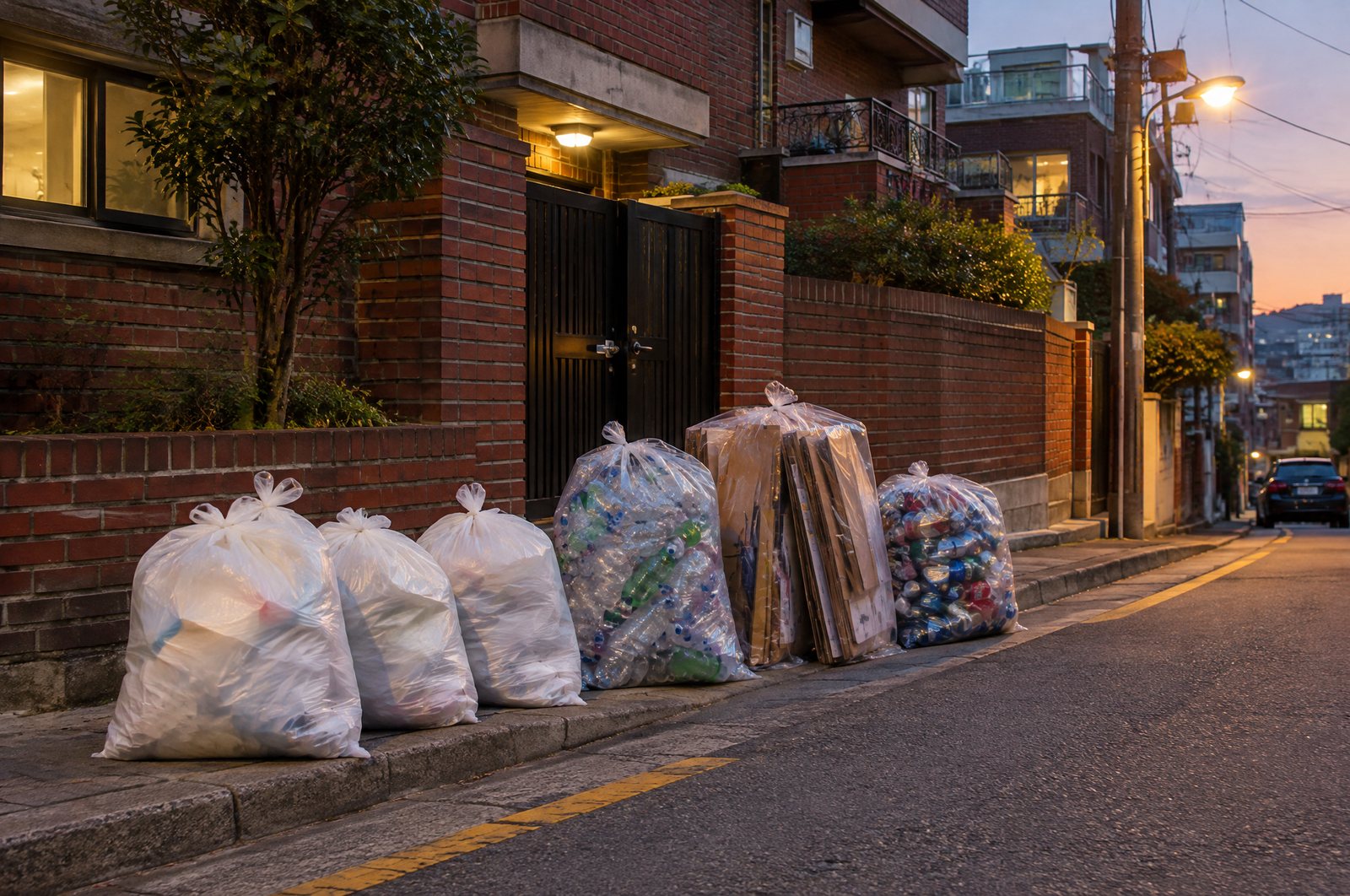
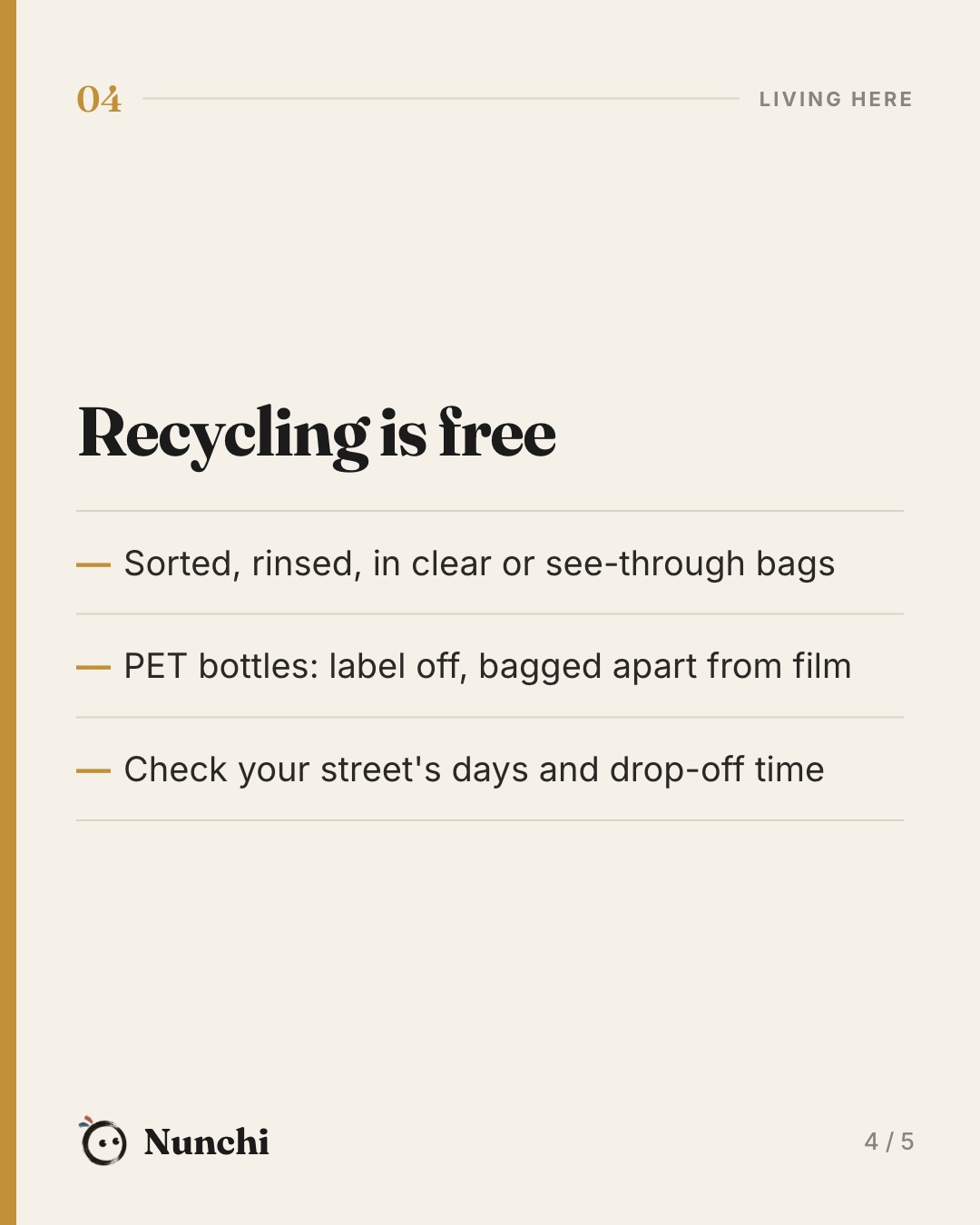
Recycling costs nothing. Empty and rinse it, then put it out in clear or see-through bags. Dongdaemun-gu, for example, collects film and clear PET on one weekday and everything else on two others, set out at the door between 6pm and 9pm. Your district's days will differ.
| Type | Korean | How |
|---|---|---|
| Paper and boxes | 종이 jongi | Flatten, tape and staples off, tie in bundles |
| Milk cartons | 종이팩 jongipaek | Rinse, dry, flatten, keep apart from paper |
| Clear PET bottles | 투명 페트병 tumyeong peteubyeong | Label off, crush, own bag, not with film |
| Plastic film, snack and ramyeon bags | 비닐 binil | Empty, rinse, own bag |
| Other plastic | 플라스틱 peullaseutik | Coloured bottles and tubs go here |
| Cans | 캔 kaen | Empty, no cigarette butts inside |
| Glass bottles | 유리병 yuribyeong | Caps off, empty |
| Polystyrene | 스티로폼 seutiropom | Tape and stickers off; fruit nets are general rubbish |
Soju and beer bottles carry a deposit: shops refund ₩100–130 a bottle. Batteries go in the battery bins at community centres and apartment blocks, never in the rubbish bag. Broken glass, mirrors, ceramics and plant pots with soil go in a special non-combustible sack (불연성 마대, bulyeonseong madae) sold at your community centre (주민센터, jumin senteo).
Can't read the sorting poster by the bins? Point your phone camera at it in Papago or Naver's translate tool. More apps worth having in our Korea travel apps guide.
Furniture and big items
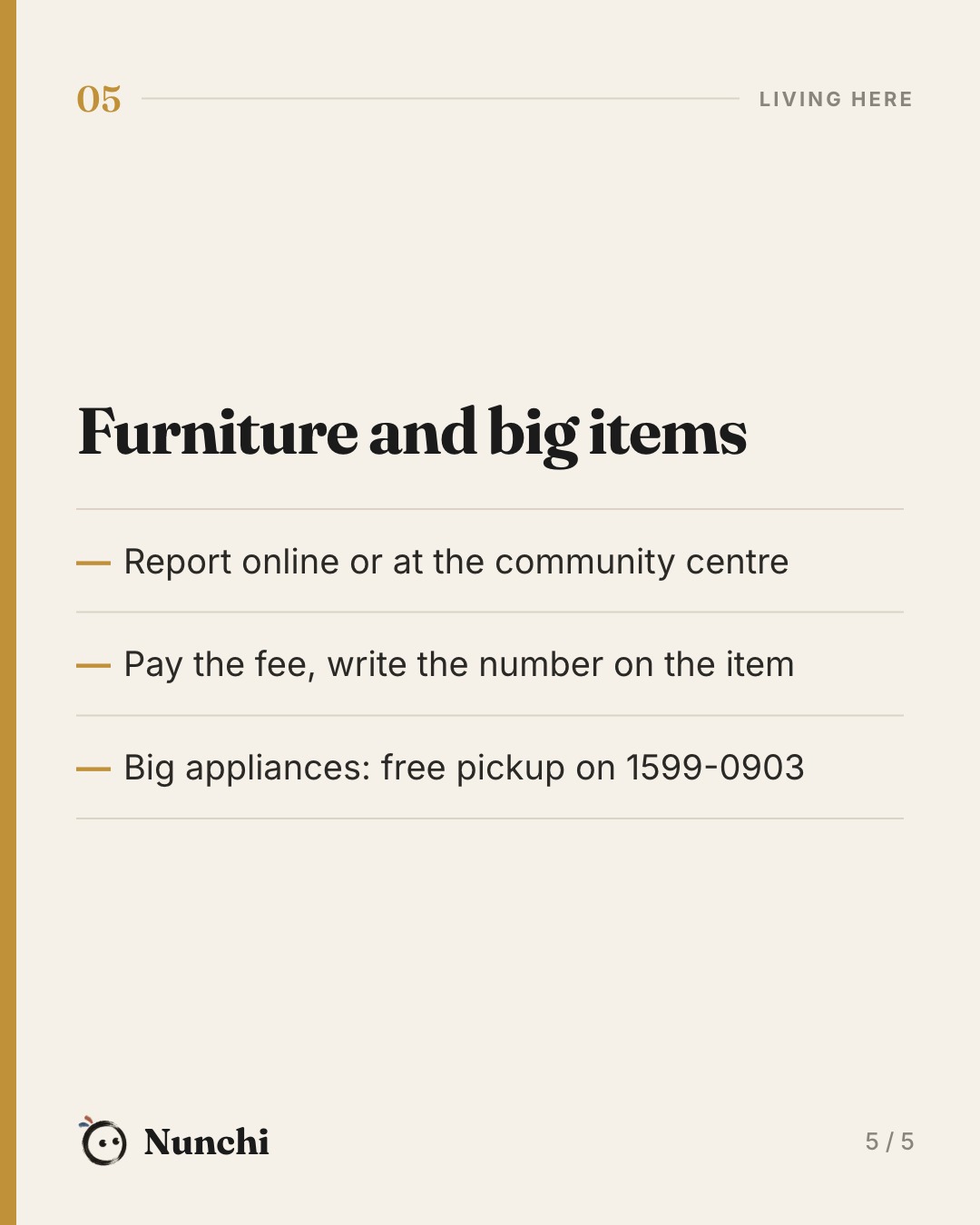
A chair, mattress or wardrobe is 대형폐기물 (daehyeong pyegimul, bulky waste). Report it first on your district office website, through an app your district uses, or at the community centre, and pay the fee. Older systems give you a sticker to attach; most Seoul districts now just give a report number to write on the item. Then leave it at the spot you're told. Fees depend on the item and the district: in 2023 a piano cost ₩15,000 in Eunpyeong-gu and ₩20,000 in Gangdong-gu.
Large appliances such as fridges, washing machines and TVs are collected free by the national pickup service: call 1599-0903 (weekdays 8am–6pm) or book at 15990903.or.kr. Smaller ones such as fans and rice cookers qualify when you put out five or more at once.
Fines
Skipping the official bag, mixing banned items into it or leaving rubbish in the wrong place can mean a fine of up to ₩1 million. Don't dump household rubbish in street bins either; they're for passers-by. Jongno-gu hands out picture guides in English and Chinese at community centres from 26 October 2026, and Seoul is producing multilingual guides for neighbourhoods with many foreign residents, so ask at yours.